Sunday, February 24, 2013

A Flood of Finches


These days, when I step out the back door to the deck, it sounds like I have entered the aviary at the National Zoo. A deafening racket of bird song greets me; non-stop twitters, zips, whistles, and other notes strung together to make a cacophony of sound that would make Stravinsky proud!  The finches have arrived! 

It seems three convergent flocks of finches have just discovered my thistle feeders that had previously been ignored, to the point that I thought I had been sold stale seed.  Perhaps I had just put them out too soon, but now, in an example of “be careful what you wish for”, I have oak trees full of finches and their close relatives. 

The American Goldfinch is here for the winter, in drabber garb but entertaining still in their dipping “pot-a-to-chip” flight and twittery ways.  I used to tell my walking ladies that they could always remember the calls of goldfinch if they would just remember that they “talk” constantly, hardly stopping to draw breath, not unlike their fearless guide who operates pretty much the same way! 

But now, I am in the Hill Country of TX which is the eastern part of the range of the Lesser Goldfinch, who it may be pointed out, is only Lesser by about a ¼ to ½ inch in size, but are no means “lesser” in sound production.  Eh gad!  They seem like the American Goldfinch on speed!   Sounds tumble out of them like crazy!  A “song” that incorporates songs of other birds but comes out so fast that I could never hope to catch whether that part was from the Ash Throated Flycatcher (whose song I wouldn’t recognize anyways!) or a Verdin (ditto on not knowing that either), or a scrub jay, which I would know.  They are said to mimic those birds and then some but I surely will need more practice before I can pick them out.

The males are strikingly handsome, with black that covers their head and backs when they are in breeding plumage.  I won’t get to see the brilliant yellow of the American Goldfinch for it will head north before breeding season but I may get lucky and have the Lesser nest in my yard for they are year round residents here.  They, like other finches, love thistle and anything in the sunflower family to include dandelions and I have plenty of both.  We are lucky to have a natural gas line that runs behind the property providing just the weedy kind of cover so many birds like, and host plants for so many of the butterflies that are constantly cruising about.

But even louder than these high-speed, singing goldfinches are the Pine Siskins who often play a “birds of a feather flock together” scenario with the finches.  They are streaky birds that you might mistake for a sparrow, but to look at its slightly curved bill and the yellow that the males sport on their wings marks them out as Siskins.  And their call is also nonstop with the added interspersing of a  “Ziiiiiiiipppppp” that has been likened to a piece of paper ripping slowly.  It was an unfamiliar sound to me and the amazing thing was that, although it sounded like there were huge numbers of them in the trees, it took me the longest time to actually “see” one.  They favor the tops of trees, so although I could catch motion in the leaves, and practically needed ear protection to stand under them, I just couldn’t get a clear look.  Until of course, they too discovered the thistle feeder and now I can see them eye-to-eye whenever I want.

I mentioned I put this under the “be careful what you wish for” category because once they DO discover the thistle, they can’t get enough of it, and if you have priced thistle lately, you know that you can either afford to feed the birds, or feed yourself.  But we can tighten our belts for awhile for the Americans will be headed north soon, and the Pine Siskins are said to be erratic in their movements; now you see them now you don’t.   I don’t remember any being here last winter, and yet this year, here they are, so, enjoy the moment. 

The Lesser Goldfinches are here year round so maybe I will get to watch their courting, high-speed chases through the trees and the sweet touching of bills, soft coos,  and offering of seed to each other that lets you know “finch love” is in the air.

Well, I pointed out that the way to remember all these finches was that they “talked too much”, rather like I am doing right now!  I have carried on long enough and will now let you return to the bird sounds in your own back yard that are perhaps ramping up no matter where you live.  Chickadees in the north are probably already making their “fee-bee” calls as they set up breeding territory and cardinals are waking you with their “cheer cheers” and oh, my missed Song sparrows, are ready to spill out their often repeated calls.  Even if a blizzard is in your weekend forecast again, know that winter is on a downhill slide and all the birds know it.

Friday, February 15, 2013

A Bird in the Hand....


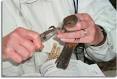
….is easier to identify than a bird in the bush!  A few weeks ago, I mentioned how difficult it was to correctly ID the flocks of sparrows that would fly up, unnoticed from the ground, as soon as I approached the bird feeder.  Even with 20 or so flying up in my face, I couldn’t get a single good look before they melted into the Ashe Junipers.  Chock them up as sparrows and leave it at that but then, I had an opportunity to go to a demonstration of bird banding at the local state park.   Now, with the bird literally in my hand, I could actually see all those field marks that before I had just read about.

First, a word in defense of sparrows, “Oh, its just a sparrow, don’t bother trying to ID it, just call it a LBB (little brown bird) and move on.” Or, many of us equate “sparrows” with the noisy House Sparrow that was introduced from Europe and has taken over every tree in every Wal-Mart parking lot and perhaps your hedgerow too.   I wrote a blog about resorting to withholding food from the other birds to get rid of the House Sparrow population I had acquired, which by the way, in time, did finally work.

Our native sparrows are in a different family altogether and are really lovely little songbirds.  I loved hearing the “Old Sam, Peabody, Peabody” of the White Throated Sparrow on the Cape, and the series of dry chips that the Chipping Sparrow repeated again and again in the spring and the interesting fact that my Song Sparrow had a different dialect than perhaps your Song Sparrow.  Ah, but now I am in Texas and singing sparrows will be but a memory for I am in their wintering grounds here and they save their best melodies for the dating games to come up North in the spring.  

However, this bird banding experience was perfect for showing me up close what I should look for.  I had seen flocks of sparrows explode out of the fields of the Wildlife Rehab place I volunteer at, large grassy fields perfect for this grass loving Vesper Sparrow.  For that matter its scientific name is pretty redundant, Pooecetes gramineus  which means “grass dwelling, grass loving birds” and that’s where I was seeing them.  They have white feathers on the outer side of the tail that you really only see in flight but that makes them a fairly easy ID.  “Vesper”, as in singing beautifully at dusk, but again something I will have to listen to on line for they won’t be doing it here. 

Another new sparrow for me was a Lincoln Sparrow, which I assumed had something to do with Abe. Maybe they found it in IL or perhaps it was an extremely honest bird.  But no, it was named after Tom Lincoln, a 21 yr old from Maine who had gone on a birding expedition with Audubon himself in 1833 and had succeeded in collecting it, so, it was named after him.  Who knew?  This is a really shy sparrow, said to be afraid of it’s own shadow, that stays really close to the brush.  The only reason we got to catch it was there were about 20 of us walking and clapping our way through the brush herding whatever was there toward the fine mesh nets that stretched across the field. 

Speak about a need to be dexterous; I could never make bird-banding my avocation. I am way too clumsy with my hands. But Craig Hensley, our leader, the head Naturalist at Guadalupe River State Park, was so skilled at it. He handled not only extricating them from nets, but then holding them gently and showing us the primary feathers, the secondaries, feet, beaks etc,. Then, with tiny tools, he measured different parts to the bird’s wings and finally attached the small coded ring that would help them identify it later if it was caught again.  He even held the bird up to our ear so we could hear the drum roll of a heartbeat it had.  In the end he placed it gently in a child’s hand and let them have the treat of releasing the bird.  Wonderful!

So just a LBB?  I think not; a bird, just as worthy as any other of our attention and admiration.  And to all my Cape Cod friends, think of me next time you hear “Old Sam Peabody, Peabody”, especially the treat of hearing a young one who is just learning and can only get out the “Old Sam, Old Sam” what was that next line?” I loved that!  But you have to wait, spring isn’t quite at your door yet!  But it will be, the snow will melt, the birds will head north and then you will have my envy. Till then, think of me out in this now, lovely weather, getting the hang of who is whom in the LBB world. 

Monday, February 11, 2013

May Day, May Day

Interestingly, I have been monitoring the "perfect storm" that has just hit my dear home of Cape Cod when I found myself in my own mini "perfect storm".  I am about to have some minor surgery on a leg, in about an hour for that matter,( I am writing this at a military base while I wait, ergo no pictures today), and I will have to stay off my feet for a few days.  I have been saving up all the blogs that are clogging my brain and had hoped to write them while I was in a forced to be inside, when my dear computer started making distress noises and now is in more of a need of a doctor than I am.  And of course the irony is, being home bound for a week means I can't take it anywhere to get it fixed.  So, this is just a short blog to explain why I am not blogging!

It has been an out of body experience watching "Nemo", and by the way, when did they start naming winter storms?  I skyped with my daughter in Maine and got treated to scenes of blowing snow; I watched the weather channel and saw pounding surf and shots of sideways snow, then stepping out the door into 70 degree weather, I saw that the first flowers, the "wind" flowers are already coming up!  The rest of the world takes this in stride but for me it is just mind boggling even though this is my second February and I should begin to understand that means spring here.  Still, old expectations die hard. 

The Texas weather has been admittedly gorgeous!  Not hot, not cold, just right, 60's and 70's which are my idea of perfection.  It sets off crazy over-zealous planting ideas.  I had to come to the base with my husband and while I wait for my appointment I filled the car, for the second time this week, with native bushes, flowers, and even small fruit trees.  They are so amazingly affordable at this nursery that it seems a shame not to try some and, of course, they look lovely now.  What is the nursery man's motto?  "We grow 'em, you kill 'em", which is about right in my experience.  So they are all shiny and green and looking grand now, but we shall see who holds up through a Texas summer.  They stock mostly natives so that is good, but some of my tried and true natives I put in last year seem to have gone belly up over the winter.  If you don't succeed at first...

The hardest part of such misplaced optimism is the work it will require to "plant" them.  Think some dynamite would be helpful in my box of garden tools, or at least a pick and axe and willingness to swing them.  We are on the Edwards Plateau, almost pure limestone with a thin skin of soil.  However, our personal yard slopes down towards a creek and the soil of the hill luckily settled on the bottom half of the yard, so you can actually dig there.  But whatever you put there will have not only soil but unrelenting sun. But I, once again, will naively believe the tags that say these dears were born and bred here and should love the sun.  We shall see.  But it is spring and hope, as they say, springs eternal so why not.

Well time to scrub up and get to surgery.  In an extra measure of caution they seem to recommend that the patient scrub up with the same thing the doctor does. I am lucky my husbands office has a shower for after walking the dog and messing around with plants I might have picked up a microbe or two. And if a miracle happens, and the computer fixes itself, I hope this week will see some true nature blogs, not just stream of consciousness writing, be published.   We shall see. To friends on the Cape, I am praying no real damage happened although I am sure the beach is greatly re-altered. And I am sure that you will tell me all about it when  you can. 

Monday, January 28, 2013

The Gift of Waxwings


I recently celebrated my birthday, and yes I celebrate, no matter the age; it just seems a wonderful excuse to pamper yourself, even if in small ways.  I have found a number of places I enjoy volunteering at here in Texas, but, as it happened, on my birthday, due to a cancellation I ended up with a delightfully clean slate.  I could finally take down the Christmas decorations, which with a backdrop of 70 degrees seemed a bit incongruous. 

But the way I would “treat” myself on this day was to stop occasionally and head out to the deck to indulge in some bird watching.  I recently moved most of my feeders further from the house for a few reasons.  First, the seeds were making a messier-than-usual mess in this deck whose boards are separated just enough to catch the seeds and start them growing.  Secondly, on any given day, you could hear the disturbing sound of White-winged Doves whamming into the window.  I have decals on the windows but that doesn’t seem to solve the problem.  However, because these birds are as sturdy as little flying tanks, they often just bounced off and flew away, but still, they must exude considerable oil, for I have all these dove imprints on windows I can’t hope to reach to clean. 

And so, the feeders are now among the Ash Junipers. The birds have plenty of cover for recently, Sharp Shinned Hawks have been around dining on the stunned doves and titmice, and with them at a greater distance I could finally use my binoculars again.  On the Cape I loved my daily walk and my companions were always my dog and this great pair of binoculars my daughter gave me at Christmas.  They were as much a part of my wardrobe as gloves and scarf, but here, with the feeders so close, and the walk around the neighborhood involving a leashed dog, my binoculars were sitting idly by.  So, on this my birthday I would treat myself to taking “bird breaks” after completing each task.

First several viewings humbled me to the fact that I have yet to know who is who in the sparrow world of TX, at least in the winter sparrow world.  I am pleased to say that, that “Greek Austerity” plan I put into place (see past blog on the topic) has reduced the number of way-too-easy-to-identify House Sparrows.  Now, however, winter sparrows have arrived and, all I can say is, even if there are twenty on the ground, they still seem nearly invisible and when they fly up simultaneously into the Junipers, I lose them completely. 

But then, while I was straining to see maybe a white eye ring, or a tawny cap I suddenly became aware that right over my head was a flock of some high pitched calling birds.  I KNOW that sound, ah indeed, and on my birthday!  A flock of Cedar Waxwings had filled, literally filled, the top of the Live Oak I was under. At first, I only heard them but then scanning the branches with my binoculars, I saw they were everywhere!  Happy Birthday to me!!!

Now, not only are these gorgeous birds, but they come complete with so many cool facts.  Want to hear some?  These are gleaned from the Cornell Ornithology webpage that is always THE “go to” site for the best information on birds.  Here is some of what I read today…

-The “waxwing” part of the name comes from the fact that some of the birds have waxy red secretions on the secondary feathers, perhaps to attract a mate.

-In the 60’s, that wild time in our history, some Cedar Waxwings started sporting orange rather than yellow tips on their tail feathers.  They found that with the spread of an introduced honeysuckle that had red berries, birds that dined on these while growing their feathers had the orange feathers.  Darn, not much honeysuckle in TX so I can’t check this out, but all of you in the NE could.  Watch for it and let me know if you see any this year.

-They are one of the few NA birds that dine on so much fruit and hah! because of this, the cowbird that decides to lay its egg in a waxwing nest will come to naught for their young birds can’t survive on a fruit diet. So there.

-We clearly need more Public Service Announcements aimed at the Waxwings warning them of the danger of overindulging in fermented fruit for the alcohol in the fruit not only can leave them with a horrid “morning after” feeling but can outright kill them!

-File under the “ahhh…how sweet” category- male Waxwings will offer their mate small gifts when courting; a berry, an insect, or, and I love this, a flower petal.  She hops away with it, but then, hang on to your anthropomorphic hat, returns and says, “no you take it” and gives it back to the male, who in turns insists she has it.  They do this a few times until she finally accepts.  How can you NOT anthropomorphize when you read something like that! 

So, can you see how a tree full of Cedar Waxwings is a great birthday present?  And I really need to appreciate them when they ARE here, for whereas they were year round residents on the Cape, they wisely, like all rational folks, only spend the winter in Texas and then, head north.

Well, this was perhaps longer than it should have been, but you see, throughout my birthday month, I have leeway to get away with all kinds of things-  lengthy blogs being one of them.

Friday, January 25, 2013

Take a Walk on the Wild Side


I have been in Texas a little over a year now.  Those of you who have been reading this during that time know that one of the hardest things for me to adjust to here, besides the heat, was having to walk my dog on a leash rather than letting him romp through the woods and by the sea unchained.  We were both pretty sad about it.  The irony was that I live where there are miles of hills and pastures but it is all private property, fenced and often sporting signs that say “We don’t call 911” which, I can only take to mean, that they shoot first, ask questions later, so it seemed not worth the risk to trespass.

Then one day, returning from church, I noticed a TX flag and an open fence leading to an area of some 50 acres that was “for sale.”  Now, I had just read a book by a TX naturalist who said, “Before you bought land, you should walk it for a year, get the feel of it under your shoes, and then consider a purchase.”  Hot dog!  Just the benediction I needed to feel free to walk this parcel with dog off leash for a year while I got the “feel of it under my feet”.  And indeed, I did.  It was THE best place for finding coyote scats and signs of wildlife other than just deer and more deer.  It even had a watering hole that provided swimming for the dog and great track-sighting opportunities for me. Of course, that dried up in summer and we went less then for it was just too hot.  But now “winter” is back so the dog and I are “walking the land” again.

Two weeks ago, when we were there, we came across a deer kill, a buck with a large set of antlers and I made note to self to keep checking on the site in hopes that once all scavengers had cleaned it up, I might have a set of antlers to use in my walks.  I wasn’t sure what to make of the kill, just absent-mindedly thought perhaps a hunter had injured it and coyotes had finished it off.  However, the very next day, I returned, this time with my brother-in-laws grandchildren and 8 adults to show off this great spot.  They of course loved seeing the bones and the cool addition of realizing that right in the middle of the kill site were hundreds of pupas.  We deduced that they must have came from maggots who had had a feast here, pupated and moved on as flies.  Kids love this sort of detective work; the grosser the better.
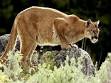
Now, in my year of walking this area, I have never come across any other people.  On this day, when I have 15 people in tow, of course I would come across, gulp, the owners?  No, just some workers who were clearing more trails to enhance its sale prospects.  They were friendly and seemed to have no trouble with all of us being there but before we parted ways they gave us an admonition to “Be watchful, a mountain lion was spotted here recently.”  A MOUNTAIN LION!!  A real mountain lion?! How cool is that!  Amazingly, over-the-top cool!
 
Then it hit me-that buck; maybe it was a mountain lion kill!  We went back to look more carefully at it, and this time I noticed that the rib cage and backbone had been separated from the main body and were several feet away from the rest.  The ribs were sheared off from the bone and wow, oh wow, when I read about mountain lion kill sites, this is exactly what they do.  Not only that, but the rest of the body was further up the hill, against a ledge that was right at the edge of the woods. The kill was probably weeks old, think of the pupated flies, but, and this is conjecture, it would seem as though it might have eaten the insides where it had brought it down, then dragged the rest of it further up towards the edge of the woods where we found it.  Maybe.  One can’t be sure.

 But, the other “smoking gun” was the scat I had noticed the first time I saw it, it was straight and gray, not like the twisted coyote scat I often found there.  Looking that up in Mark Elbroch’s amazing book of, “Mammals Tracks and Sign”, I found the scat in the photograph to be identical to the one I had seen.  Wow, wow, wow! 

Now, of course, some people are saying, “Surely you won’t walk there anymore”, but lets think about it.  Male mountain lions have a range of 20-200 miles, and females 20-100, so if we even take the least amount of 20, it doesn’t seem likely it will be hanging around here everyday.  They hunt at night and at the crepuscular times of dawn and dusk, so it would seem if I go at high noon, there should be no worries.  They also are shy animals, with plenty of deer to eat, so I shouldn’t expect to find myself on their menu.  However, the dog, which is getting older, is probably the one I might worry about.

But believe me, it made my day just realizing, I, for the first time ever, lived in mountain lion country.  Taking a “Walk on the Wild Side” just got a little wilder and I love it!


Tuesday, January 8, 2013

"Cedar Fever" another Proud Texas Tradition


Surely the makers of Kimberly-Clark must delight in this season.  Thousands of boxes of Kleenex will be sold to we poor sods who will spend 50% of our day blowing our nose and itching our eyes.  The season of “Cedar Fever” is upon us.  Last year we moved here in the midst of it, and while many were suffering around me, I was thankful that my Yankee constitution would not be bothered by the Ash Juniper that makes up half of the trees in my yard. 

Well, clearly, I counted that blessing too soon.  I don’t know if that is typical, that a newly moved body is too behind the curve to react the first year to allergens, but this year, my nose and sinuses are on top of things and from the moment my plane touched down from Maine, I started sneezing and didn’t stop for at least three days.  “Cedar Fever” has claimed another victim.

Now, Cedar fever is a misnomer in two ways.  First, the tree is really an Ashe Juniper (Juniperus ashei) and although innocent, newly-moved, moi comes down on the side of this tree being good as wildlife cover and holding the soil in place, most native Texans get a murderous look in their eye when you mention them and recommend you cut the whole lot down immediately.  Their reasons being they “take up a lot of water”, but you know, I beg to differ.  Like all junipers they have the small scaly “leaf” adapted for water retention and they are NOT huge water users but are well-adapted, drought resistant trees.  Birds and mammals alike love the berries of this juniper, and the bark that is so easily stripped is used as nesting material for many birds.  It turns out the jewel of the Hill country birds, the endangered Golden Cheeked Warbler, insists on using old stands of Ashe Juniper to nest in, no other tree species will do.  So without these junipers, the bird will lose their tenuous hold on life.
 
In keeping with everything is bigger, grander, etc in TX the amount of pollen the male trees put out from Dec- Feb is stunning.  The amount considered “heavy” is 500 grams per square inch and I read that last year at this time the trees were producing 14,680 grams!  They expected the same high yield this year, so yikes, no wonder I can’t stop sneezing!  It seems the key to its creating such an explosive stir in us is that the biochemical structure of the junipers pollen protective coat has properties that make it unusually noxious.  File under “everything bigger or more dramatic in TX”! 

On the Cape, I was surrounded by Eastern Red Cedar, (Juniperus virginiana) and Common Juniper, (juniperus communis); the latter one produces the berry that is used in the making of gin.  I read one article that said if only you could make gin from the TX juniper you could drown your sorrows over your allergies.  No such luck though.  But you can make some of the sturdiest fence posts and with pastureland fenced for miles and miles here; you would think that would win some fans.

 
 Well, sniffle, sneeze and blow on; my cedars are full of White Winged doves, Black Crested Titmice, Golden-fronted Woodpeckers and soon, if my memory of last winter holds true, Cedar waxwings will come through and turn my trees into holding places for those stunning, Egyptian-drawing birds, with their black eyeliner and tidy crest.  I’ll take my Vit. C and use my nasal rinse and remain a supporter of this maligned tree.  At least, that’s my optimistic plan, but then I am only in the first weeks of this, check back at Valentines Day and see if I am still singing it’s praises! 

Tuesday, January 1, 2013

"Here Comes Suzy Snowflake"


 “Here comes Suzy Snowflake
Dressed in a snow-white gown
Tap, tap, tappin' at your windowpane
To tell you she's in town.

Here comes Suzy Snowflake
Soon you will hear her say
Come out ev'ryone and play with me
I haven't long to stay.

If you want to make a snowman
I'll help you make it, one, two, three.
If you want to take a sleigh ride
Whee! The ride's on me.

Here comes Suzy Snowflake
Look at her tumblin' down
Bringing joy to ev'ry girl and boy
Suzy's come to town.” 


Tepper and Bennet


You have to be of a certain age, perhaps even raised in the Northeast for you to know the tune that goes with this old 50’s hit by Rosemary Clooney.   It was made into a cartoon that seemed to play endlessly every Christmas and how I loved it.  It is amazing how one’s mind holds onto lyrics FOREVER, so during any of the three snowstorms we had while I was in Maine this Christmas, you could find me by the window singing this song to my young grandchildren who would “tap, tap, tap” on the window pane on cue whenever we sang it.

And how the snow did “tumble down”.  I think we received some 20” while we were there and it made Christmas perfectly, perfect for this homesick New Englander.  We are back home in Texas now and catching up on some old taped news programs.  They made it all sound so awful and dramatic, which sadly it must have been for those who were in accidents because of it. But if you were by the window singing with children, or watching it swirl off rooftops under the floodlights, or walking knee deep in the softest, lightest, snow pulling grandchildren in a sled behind you, than it was beautiful beyond belief.  It was so cold in Maine; single digit mornings, highs in the 20’s, that this was that “Ivory Snow” snow, easy to shovel, easy to walk through, the kind that does blow off rooftops like some scene from  “White Christmas”- in a word, lovely.

Shall we marvel for a moment at the delight the water cycle brings us?  In Texas I am a bit water cycle deprived, although the best Christmas gift ever was waiting for me when I returned home- 2 days of real, much needed, rain, and thick fog!  Perfect for unpacking and settling in.  Too much warmth and sunshine would have been hard to take after such “Currier and Ives” weeks in Maine.  Thank you God. 

The water cycle also made our trips to the airports pretty exciting each time.  On the way there, water in the form of ice and sleet cancelled the third leg of my flights to Maine resulting in a miracle of being rerouted, for no extra charge, to the airport 10 min from their home rather than the 2 ½ hour drive.  Then when it was my turn to pick up my daughter and husband in Portland, snow had already fallen, making my “wrong way Corrigan” trip to Canada a scene from the Polar Express. (See previous blog for my, minor but significant, error of heading North rather than South on Rt. 95 and not realizing my mistake until I reached Canada!)  Of course, once I turned around and headed the 200 miles back in the right southerly direction, I ran into the liquid form of the cycle in its most torrential state.  Coming down in buckets, meaning I was reduced to going 30mph with flashers.   

Then, when it was, sadly, time to head home, another 150-mile adventure to the airport, changed from a dusting of snow, to nearly a full-blown blizzard.  My youngest daughter headed off in sideways snow to Boston, Hap and I slept at the airport and my daughter and her family, crawled back through 3 ½ hours of nail-biting driving, once again, brought to you by the water cycle.  But they “arrived alive” by midnight so I was relieved.

Next morning, I flew through the condensation part of the cycle with clouds billowing around the plane and giving us a bouncy ride till we landed in Texas.  On New Years Eve, if Santa had chosen to go celebrating, he would have needed to be piloted by Rudolph for sure.   Even as I type this, the world is gray with fog and a buck has just stepped out of the gray to eat away a bit more of what remains of my Esperanza.  But my Christmas lights are glowing and its cozy inside and I am full of good cheer.  “OOOOOooo I really love weather!” said with Eloise-style enthusiasm.    

So here’s to the Water Cycle, clearly we wouldn’t be here without it. And here’s to the God who set it all in motion.  Thank you God, how I appreciate it!  Happy New Year everyone!