Wednesday, August 6, 2014

The Buck Stops Here-Part Two-Antler Growth


As promised in the last blog- let’s talk facts and fiction in the antler world.

Fact: A bucks antlers are the fastest growing tissue in the animal kingdom!  At the peak of their growth they can add ½” a day.

Fiction: You can tell the age of a buck by the number of points on its antlers. 
No, the size of the rack tells you more about the nutrition of the animal; whether it weathered a hard winter or not.  The better the diet; the larger the rack.

To accurately age a deer, you would take a slice of its tooth (something a live deer is not going to be up for!) and have an expert count the “rings”, it’s annual growth, under a microscope. 

Fact: The velvet that covers the antlers as they grow through spring and summer is skin that is rich with blood vessels.  When testosterone begins to increase at the end of summer, it is a signal for the blood flow to stop. The antlers, which are bone, start to harden and the “velvet” is rubbed off.
 
Fiction:  Once the velvet is rubbed off, they will stop scraping your trees. NOT!  They continue to rub their antlers against the trees to help strengthen their neck muscles for the upcoming territorial challenges.  My poor trees always look like they have been through a war by falls end but so far it hasn’t out and out killed them.
 
Fact: Bucks must be careful of their antlers in summer during their growth. Any hard bumps could leave them deformed for the rest of that year to say nothing of the possibility of bleeding.  Tip toeing through the junipers must be their summer gait.

Fact: A really well fed, young buck, like the ones in our neighborhood, can sport a decent rack even before their 4th birthday.  Deer continue to grow until they are 4 so most of their nutrition goes into gaining skeletal mass. However, if you live in an area where we all fall prey to those liquid eyes, then the young stud gets extra calories to grow some decent antlers.

Fact: If you find a deer skull where the deer died “with his antlers off,” rather than “with his boots on”, you can still tell male from female.  The male skull has bony outgrowths called pedicels that the antler grows out from and a doe skull won’t have these.  If you want to be “uber” nature detective; the larger the pedicles the larger the antlers and, until it died, it was a well-fed deer.
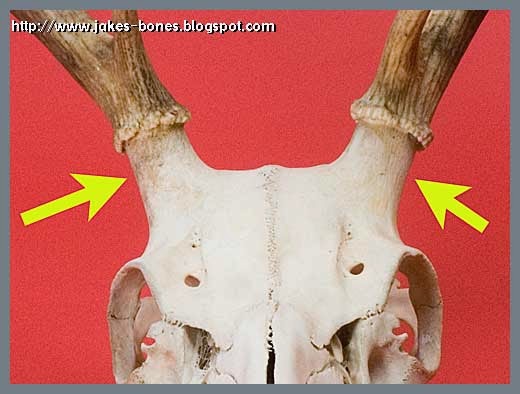
Fact: Antlers are shed between Dec-March with the healthiest deer shedding their antlers later in the season.

Fiction: The terms horns and antlers are interchangeable.  No, a horn is bone that is a growing part of the animal’s body (think cows, rhinoceros, antelope etc) and is never shed whereas the antlers are shed once a year.

Fact: We have heard enough facts Pat! Let us get on with our lives! 

OK, me too. I leave in 36 hrs for a 5-week sojourn to the Northeast.  The one-legged- naturalist gimps north to her ancestral hunting grounds!  In true, pick-the-worst-possible time-to-die form, my computer expired last weekend.  I am thankful for a very old Apple that is doing it’s best, but if these blogs fall off for a while you will know why.

Wishing you all the best in this waning summer. Hopefully I will find a way to blog from the road. There will be much beauty to be seen, dear friends to be met and a family all together, to explore Ann of Avonlea land. What could be grander?


Wednesday, July 30, 2014

The Buck Stops Here


Actually, several bucks stop here.  I live in one of those fenced in communities that has more deer per acre than people.  As it is fenced, it seems they are here to stay and looking for handouts.  When I moved here, I was surprised to find so many people feeding them, especially as these same people complained about how many there were. But perhaps the feeding is a sort of “protection money” thing.  “If I feed you, do you promise not to eat everything I planted in my yard?”

At first I pooh-poohed it.  I am a naturalist; I know the concept of “carrying capacity”.  The more you feed them, the freer they will feel to multiply. But then, they started showing up in my front yard.  Here they came, majestic bucks with huge racks, does with those liquid eyes.  Filling the front yard and how can an Italian, hard wired to feed things, resist?

I wasn’t going to give in to buying corn; that is essentially like feeding them cotton candy. Buying actual deer food wouldn’t sit well with my thrifty husband.  Instead, I started tossing out vegetable scraps, things that would go into a compost pile if I had one.  Scraps, that on Cape Cod, I just turned into my garden.  Here in the Hill country “turning” something into the “soil” only works if you are willing to wield a pickaxe.
griffinsguide.com

 Now I am hooked, and they are hooked.  Early morning visits treat me to sights of fawns on wobbly legs and bucks going through their antler development. However, for about 10 days after I broke my leg, I could barely move, let alone get food out to them and it about killed me.

Amusingly, they would all line up, facing the house, staring at the door as if to remember some incantation that would make it magically open and deliver food. Creating more angst for the hard-wired-to-feed Italian that I am.  Once I was finally given a hard cast and crutches, I was able to hobble out and feeding resumed.  I know, I know, I should have known better than to ever have started.  So, this is a confession of sorts.

www.mpgnorth.com
 However, I will never again be treated to watching antler development, doe pecking order, fawn growth, etc. at such a close range.  We will not be in Texas forever, so I am taking advantage of this behavior lab that is right out my door.

Next article, let’s talk about antler growth.  Many of the facts will be common knowledge for hunters but, perhaps, not for the rest of us.   Starting with dispelling the myth that you can tell a buck’s age by how many points are on the antler.

 Did you know; the only female deers with antlers are reindeers?  So if you ever thought Dancer might have been a girl’s name, as in “Now Dasher! Now Dancer! Now Comet and Vixen!”, it probably was.  Next time then, “The Bucks Stops Here-Part two.”


Saturday, July 19, 2014

Birdbaths-Cheap Entertainment


http://nwbackyardbirder.blogspot.com/2011/03/attract-birds-to-your-backyard-part-4.html

I love feeding the birds.  Yes, it costs something. Yes, it is sometimes messy. Yes, it may make you face your prejudices.  “Not more white winged doves, house sparrows, cowbirds!” But, I find the rewards outweigh the costs.  However, if for some reason you are not the type to want to lay out a spread for everything with wings, an easier and often equally rewarding activity, is to get a birdbath.

Birds who are seedeaters in particular, need water.  When is the last time you ate a “juicy” sunflower seed or had some “millet juice”? Never, right?  And so it makes sense that birds that are strictly seedeaters are the ones visiting your feeders and the ones who, even if not offered seed, will be in need of water.  Birds who primarily feed on insects or fruit won’t be coming to drink perhaps, for juicy is the caterpillar they just ate.  However, the need to bathe eventually draws them in.  And that is what makes a bird bath a marvelous venue to see even more species of birds than you would at a feeder. 

Feather maintenance is key for birds.  Let your feathers go unpreened and you are in deep trouble as a flight-oriented animal.  Of course, you don’t see slovenly birds, for bathing, be it in water or dust is instinctual. Along with the subsequent preening; running each feather through their bills to “re-zip” the interlocking parts of the feather making it sturdy again. These things are programmed into all birds for their survival. 
flicker photo

You don’t have to buy expensive or artistic birdbaths either, at least not from the bird’s perspective.  Mine is a simple plastic affair held up by a not quite complete, bird stand and a rope lashing it to the deck.  When I lived on the Cape the one thing I did spring for, and was so very worth it, was a submersible water heater that kept the water from freezing in winter.

 It delivered more birds to my deck than I ever saw in summer.  Not only to bathe, for they do that year round but also to drink when the world was frozen and snow had yet to fall.


http://weeklypaper.blogspot.com/2007/02/winter-scenes.html

Birds will eat chunks of snow for water, and I bet a lot of us have seen blue jays and the like catching the melting drops from icicles.


Another thing I love is that bird behavior is on display at the birdbath. You can witness pecking order as the dominant bird hogs the water and others must wait. You can be entertained by house sparrows that LOVE to do everything together with 10 or more splashing around together looking like one great beach party.

 For that matter, if you are disgruntled about house sparrows and their incessant cheeping, this gives you a window into what gregarious little guys they are. Perhaps it will soften you heart toward them just a tad.  After all, it was our European ancestors who brought them here for they couldn’t imagine life without the ever-cheerful house sparrow who loved to make your casa its casa.

I have delighted in watching the young fledglings figure out their first bath. And I have been stumped by the behavior of white wing doves that dip their tail in the bath and flick it over them: their idea of a shower perhaps. 

http://www.pinterest.com/jomlong/drip-irrigation/
You can easily Google information on the different kinds of birdbaths that are available.  I covet the ones that have a drip system over them for the sound of dripping water gets the attention of passing birds, plus the water is always moving so mosquitoes aren’t drawn to it as a nursery.  Mosquitoes have not proven to be a problem in mine for the water does need to be refreshed every couple of days. I use a big car brush to just swish out algae that grows on the bottom, only a minute’s work. 

So how about it Gunga Din, are you ready to bring the water?  They will thank you for it in their own splashy way.  And you will have done a little something to increase their chances of survival making the world a lovelier place.  And who can resist that!

Wednesday, July 16, 2014

Breakfast with the Birds

-->
http://dickeybirds.com/Bird_Feeders.htm

Now that I am not rushing out to the Wildlife Rescue volunteer job or any other job, early in the morning, I have time to dine with the birds.  Generally, I am up before they are. It seemed when I turned fifty I tapped into some previous life where I must have been a dairy farmer.  Up at 4 AM, wishing I had a cow to milk but I don’t, so, I toss and turn until 5AM and then rise.

When I lived on Cape Cod, the sun was well up by 5 AM and I loved slipping out to walk the dog to the bog with the dawn chorus preforming at full decibel all around me.  Here in Texas, because we are in the middle of a time zone, and so far south, the sun never makes such an early appearance.  Yet, I still wake at 4, still don’t have a cow, or a bog to walk the dog to.  Rather, I have embraced this as a good time to write. 

When the sky finally brightens, I take my position in front of the window that looks out on the oaks. With cereal bowl in hand, I have breakfast with the birds.  The golden fronted woodpeckers have had a banner-nesting season and watching them feed their young is usually the first order of the day.
 
billdraker.com
  The adult swoops to the feeder at my window, takes a seed, and then flies off to the perpendicular branch of a live oak where junior is waiting.  Wings fluttering in the classic begging posture of the young, he receives his seed from Dad.  

Then the adult returns for a hunk of suet, back to the tree and down the gullet that does; it must take 8 or 9 trips before the gawky looking, young one is sated. Now, I can’t tell which fledgling belongs to which adult, but the adult sure knows.  Once, another young one came looking for handouts and was quickly chased away. 

More “wing fluttering” going on with cardinal fledglings and parents.  Just yesterday, I saw a young male cardinal shamelessly begging from an equally young female. “ Get your own seed Buster!  I am not your Momma!”  seemed to be her response.  And he eventually did.

 Ah, but what is this; a HUGE, noisy, fledgling begging from a diminutive, female house finch.   The disproportionate size of the young lets me know I am looking at a cowbird.  This species has always reminded me of Lazy Maizy in Dr. Seuss’s “Horton Hatches the Egg.”

wikepedia

The female cowbird lays her egg in another bird’s nest, often one quite a bit smaller than the cowbird.  Consequently, the young cowbird nestling has the biggest gaping mouth and is fed ahead of the bird’s own young.   Often, they even kick out the other nestlings. 

Now, it is most likely the only surviving one and follows the bedraggled mom begging and begging.  It’s an effective strategy, but still, one that makes me feel for the duped parent.
cowbird with yellow warblerhttp://travelswithbirds.blogspot.com/2011/07/brown-headed-cowbird.html

 And so each morning goes, a peek into the world beyond my window.  I bet a number of you get to see similar morning rituals played out. Feel free to share, for this is how the body of knowledge of bird behavior grows. “ Each one, teach one”.  It’s a good motto to live and learn by. 

Oops, if I read my own blog I would see that when last I wrote, I was promising more info on the importance of water for birds.  Ah, forgetful me. Let’s see if I can remember NEXT time, that I said I would write about that next time!
http://fineartamerica.com/products/birds-drinking-from-bird-bath-in-summer-sunshine-gordon-wood-greeting-card.html

Thursday, July 10, 2014

Babies First Bath

-->

I have a confession to make; as a mom, my weakest area was chronicling my children’s “firsts”.  Perhaps I did it for my first daughter; first bath, first words, first steps, but I am quite sure that my third daughter was not adequately chronicled.  At yet, here I am, about to put down on paper what I think might have been a young group of fledgling Titmice’s first bath.  Apologies to Laura.

From my perch by the window of my own, “Private Home for Wounded Naturalists”, I was startled one day, to see a steady stream of young titmice emerge from within a huge Live Oak branch.  These trees have impossibly long, gravity-defying, limbs that grow out perpendicular to the ground for a long way before heading up to the canopy.  This particular branch was pruned at some point due to its interference with the path.  Although I had noticed a huge scar with large cracks in it, I had no idea it was the nesting spot for this particular family of Black Crested Titmice.   Titmice, like so many of our common birds, are cavity nesters.

But now, here they came; flying practically in formation, 5 of them, over to the jasmine hedgerow that is right out the window.  On the side facing me, is a bird feeder and a suet feeder; two favorite places for this new family.  On the railing above that, sits my birdbath.  Behind the birdbath, there is a scrubby offshoot of another Live Oak branch that is the favorite queuing spot for birds awaiting the bath.


Four of the five, arranged themselves on this offshoot while one brave one entered the birdbath, not to drink but, it appeared, intent on a bath.  And yet, instead of diving right into it, he stood in the center for a long time.  The other four watched expectantly, as he slowly started to turn in a circle. Still, not starting the customary splashing, he held his ground.  I felt I could practically see the wheels turning, when, finally, he made small dipping motions with his wings.  Little splashes; more standing still; others still watching. 

“Man, up little bird; go for it; the full Monty”, was my spectator’s cheer, which it finally did.  “That’s it!”, the more vigorous splashes that would get the job done.

The spectators left their branches and began to join in, one or two at first, until the whole gang was in.  They too started with timid splashes, but gained momentum after a bit and water was flying all around.

In the next blog, why don’t we discuss how very important it is for birds to have access to water and how a birdbath is really the key to seeing the most species of birds. Not all birds are seedeaters but ALL are water “needers.” 


Now, don’t tell my daughter I wrote this.  It might open old wounds. 

Wednesday, July 9, 2014

Looking for Love in All the Wrong Places- Viewer Discretion Advised


Not to alarm you with the “viewer discretion” thing, but we will be talking about the mating habits of the Green Anole here; having found a good picture of an anole family in the making, I thought you should be warned!

I believe I have written about the Green Anoles (Anolis carolinensis) that frequent my deck here in Texas.  When we first arrived, missing my entertaining chipmunks, they had to stand in as “amusing deck animals”.  The males show up posturing on the railings, leaping onto bird feeders and “pumping up” their bright crimson dewlap, the flap of skin under their neck that is a “come hither” sign to the lady anole.  It’s pretty entertaining to watch.

Several weeks ago, prior to my accident, my daughter was visiting and we were sitting on the front deck enjoying a glass of wine, when a male anole came trotting along the railing; stopping every few feet, pumping up it’s dewlap, looking expectantly, then travelling a few more feet and repeating the process.  He was completely oblivious to us, at one point he was no more than a foot away, hanging upside down on a pillar displaying away.  

 Now, we saw no movement in the shrub beneath him or in the Sotol that he displayed at so fervently.  No lady came out of hiding to take him up on his advances, nor did any other male anole seem to be present.

Since it was the end of May, we were at the beginning of the anole courtship season, which continues through October.  Perhaps then, he was looking for a mate.  If he was, she was not impressed.  Or it could have been a territorial display, claiming every inch of our front porch as his own.  Either way, it piqued my interest to do a little research on this fairly common lizard. 

Anolis carolinensis  is the only anole species native to the US. There are some 391 different species worldwide.  They make up one of the most successful lizard groups.   Some islands in the Caribbean claim as many as 10,000 anoles per acre!  I can’t even begin to imagine the dewlap shaking that must go on there as they defend their territory.

In our country, this lizard alone can change color.  Do you think they do that as a form of camouflage?   Nope, it is a mood and temperature thing; think mood rings.  When they are cool or, STRESSED, they are brown. 


  I just saw that happen yesterday.  An anole, nice and green, was hanging out by the bird bath when, not one but two birds came, one after the other, to take a bath.  They were so intent on their business they didn’t see him, and almost landed on him while he stood stock-still.  The third bird must have been the “giddy limit” for in less than 10 seconds; he went from bright green to brown. There was no change in temperature; he must have been stressed by almost being stepped on three times!

When anoles are relaxed and just chilling, they are pale green.  When they are zippy and warmed by the sun they are bright green.  When they are angry, they get, (I love this), ANGRY eyes!  A black line appears behind their eyes making them look ever so fierce as they “dewlap dual” with an opposing male.  They will even fiercely attack their own reflection, just like male cardinals and mockingbirds that peck away at your car’s mirrors until they exhaust themselves.

When all that “come hither” shaking appeals to the female, rather than running away, she will “allow” herself to be caught.  The ensuing mating will result in her laying 2 eggs at a time over a period of days until she has laid about 10.  If the season isn’t right, say it is too cool in the fall, she can hold that thought and lay them the next spring; planned parenthood in a way.

Well, that day with my daughter, the male seemed to gesture in vain, but just a few days ago, my husband came in saying there was a shocking display of anole love going on right on our fence for all the world to see.  My crutches took me awhile to get out there; they were gone. But now I can watch the calendar and know that in 5-7 weeks some young anoles might grace my deck.  They have wider heads and shorter tails than the adults. 

As promised, here is the educational but graphic, picture of the next generation getting its start. Avert your eyes if you have delicate sensibilities.  He WAS looking for love in the right place after all.   Now, if you have anoles where you live, YOU can expound on them to anyone willing to listen.  As I just did!


Saturday, June 28, 2014

Defying Gravity


If you have seen the play “Wicked”, you will have to pause for a moment after reading the title of this blog and sing the song.  A FABULOUS song wasn’t it?  I might also pose the question, “Is gravity getting your down these days?”  Probably, it is.   If you saw the last blog, I mentioned a T-shirt I saw in that ever-entertaining, catalogue, “Wireless”.  It said, “ GRAVITY-IT’S NOT JUST A GOOD IDEA-IT’S THE LAW”.   Love that.

I think we all know, from watching floating astronauts that, yes, it looks like fun to be weightless, but actually, when I take a sip of coffee, I am thankful it goes down my throat rather than floating up to the ceiling.  However, each day we are treated to the sight of animals that defy gravity on a regular basis- the birds.  Of course, they aren’t defying it really, but with the addition of feathers, bones that are hollow and a skull filled with more air sacs than yours or mine, flight can happen and up, rather than down, they go.


However, I can see from watching my “pre-K”, fledglings that flight, of course, takes some practice, and using those wings does take some getting used to. I imagine we have all watched a young robin or other bird species that is more than happy to nest in your immediate vicinity, take those first halting and not always, ending well, flights.  The fledgling that misses the mark in the tree and ends up on your lawn, chirping and chirping for mom, is a sight that was pretty common in June in NE where I grew up.  I was one of those interfering kids who would scoop it up, call it abandoned, and entertain myself endlessly for the next few weeks: finding it worms, meticulously changing its Kleenex nest, “teaching” it, I thought to fly, and then, weeping buckets when it did and left me.

But from my perch near the window, cast propped on a low table, I can see that beyond those tentative flights from the nest, getting the hang of what their wings can do, still takes a while.  The bird feeder nearest the window is hung on a “shepherds hook” and when my little flock of young Titmice come to feed, they more or less have to queue up for a turn.  Whichever one ends up on the curve of the hook tends to momentarily become a victim of gravity and starts to sliiiiiiddde down.  What is amusing is how far down it will slide before it dawns on it to flutter its wings and get back to the top.

Likewise my young and ADORABLE, Carolina wrens, keep alighting on the clothesline, which starts to swing, throwing them off balance and into a fit of fluttering, but still hanging on.  I can’t say I have ever seen any of the adult wrens chose the clothesline as a perching place.  Then there are the insatiably hungry, White Wing Doves which will tackle ANY bird feeder, even those expressly designed for smaller birds and have to beat their wings so much to stay on that I would think they are expending more energy than they are gaining from the seed.

Young Golden Fronted woodpeckers, trying to get at the hummingbird feeder also do more flapping than any adult one, as they try to cling on to the rim and still be able to bend their body to get that long tongue into the hole.  The adults anchor themselves with their stiff tail as they wood in a tree. That skill is coming to these young ones, but it clearly takes learning.


Life is a learning curve for all of us. And I say again, if I had to break a leg, and be confined to the house, I couldn’t have picked a better season to do it in.  If, for any reason, you find yourself indoors when you would rather be out, I invite you to your window.  If you are fortunate enough to have trees or even just a windowsill in the city where pigeons will roost, there will be something to watch. 

And I have a feeling, when the weight of this cast comes off in another 6 weeks, please God,  my left leg will have a rush of feeling like it is pounds lighter and ready to defy gravity too.  Or not; perhaps you who have had experience with this would say “au contraire”, it will feel like a leaden muscle less weight; just gravity, having its way with me again. 

Stay grounded everyone and may you find joy in watching those creatures that aren’t!